Month: July 2010

UxD- more or less

I don’t really know if this falls under product design or user experience design.

Today I stopped at my local AM/PM to get gas — $3.17 a gallon for Premium. Not bad. Not great, but not bad. As I slipped my ATM card into the pump’s interface, it asked if I agreed to the .45 cent charge. On the keypad next to the flat (i.e. not raised like the rest of the keypad) green “okay” label is the actual key with the number 1 on it. So I hit it and it took me to the next screen – “Do you want to buy a carwash”. Next to the flat red “No” is the number 4 on the keypad. So, being that the 1 on the keypad worked, naturally the 4 should as well.

As computer users, and just users of technology devices that have contextual menus, the keypad could either be used to enter one’s PIN or ZIP code, or in this case, act as the yes and no keys, as well as cancel (which was a flat yellow label next to the physical “Clear” button). So I pressed the number 4, or what I assumed to be NO…and pressed, and pressed. Nothing happened. “Do you want to buy a car wash” was still on screen, as though the pump had a camera, some for of AI, and saw my dirty yellow car (I live on a dirt road, so, well, you get the picture).

So I go in the store. “You have to touch the ‘No” button” the attendant informs me. So I go back out. Hmm, no “No” button. What if..? So I insert my card, this time trying the green label– AHA! It’s a membrane button. Same with the No button. Okay. So I get that they wanted separate  buttons for these actions. Good idea, bad follow through. Below is a graphic I put together of what they have and what I think they should have instead..
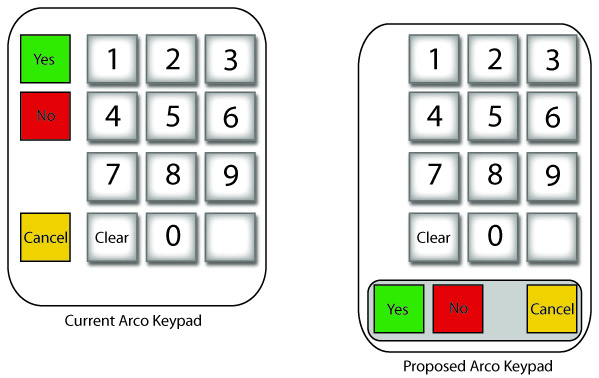
Put the buttons somewhere else

Of course there are other ways to do this and this is only one of many solutions. Whoever designed the current implementation should not be working as a designer, and most likely they aren’t anyway.

So next time you get gas, check to see if what looks like a label is actually a button.

Random Thought – Who has time to blog?

I’ve noticed that I really haven’t had time to add anything to my blog lately. It seems the last time was back in February- about the same time I got a job.

Blogs are interesting in that they can cover myriad subjects (and for those who graduated from high school with a 3.o or better average, that’s how it’s supposed to be written, not “a myriad of subjects”… I don’t know why but them’s are the rules  ; ) ). Off-subject: I really hate going to online forums where the people participating, who are adults, most likely over 40, and can’t spell or bother to even right -click on a word when it’s underlined with presumably the incorrect spelling. That’s just lazy.

To be honest, I like to blog about design, whether good or bad, and sometimes about other things that may not seem design related, but in most cases are in some odd way. My blog about LinkedIn, though some considered it just your everyday rant, was in some ways a social commentary about that site and Social Media/Social Networking sites in general, and well, how they are designed.

I commented on how I have this huge “network” and how it really did nothing to help in my job seeking activities when I was out of work. I’d send resumés and “in” messages to recruiters who were in my first degree of contacts, with zero response back. The job I have now I never applied for, sent my resumé to, “in” mailed anyone — it just happened. To be honest, I attribute it fully to God.

Not that I’m saying linkedIn is all bad. I do get emails once in a while from people I haven’t talked to in a while, and see what past co-workers and or friends and colleagues are up to lately. So, in that sense linkedIn is pretty cool. As a job finding, getting in the door tool, mmm, not so much from my experience.  And as I said in my last post regarding linkedIn and social networking in general, I’d like to be proven wrong.

We have all this technology at our fingertips designed to make our lives easier and more productive. Before “social media”, people used to network by attending meetings, user groups, industry gatherings, etc. And from those in the past, I was able to get job offers all the time. But then people got to know me face to face, see my work, watch me present at times, and the rest all kind of fell into place.

But now with that layer removed, I don’t know how technology in this sense really helps. And I don’t think anyone else, if they really thought about it really truly knows. Also, I may just be writing to a blog that no one really reads, and in a sense just talking to my own self.

That took me on and off about 20 minutes to make this post, in between meetings and work. So, I guess there is some time here and there to blog. Did I talk about design? Kind of. Not so much the visual design of social networking sites like LinkedIn, but this was more about the actual user experience design, and I think there’s a lot more that can be done to make a site like that use the technology more efficiently so it becomes a tool for professionals to find that perfect and or illusive job, especially in today’s economy and job market.

Your comments are more than welcome on this of course. And I do dare anyone to prove otherwise that LinkedIn really doesn’t help open the doors to that perfect job.

25 minutes…